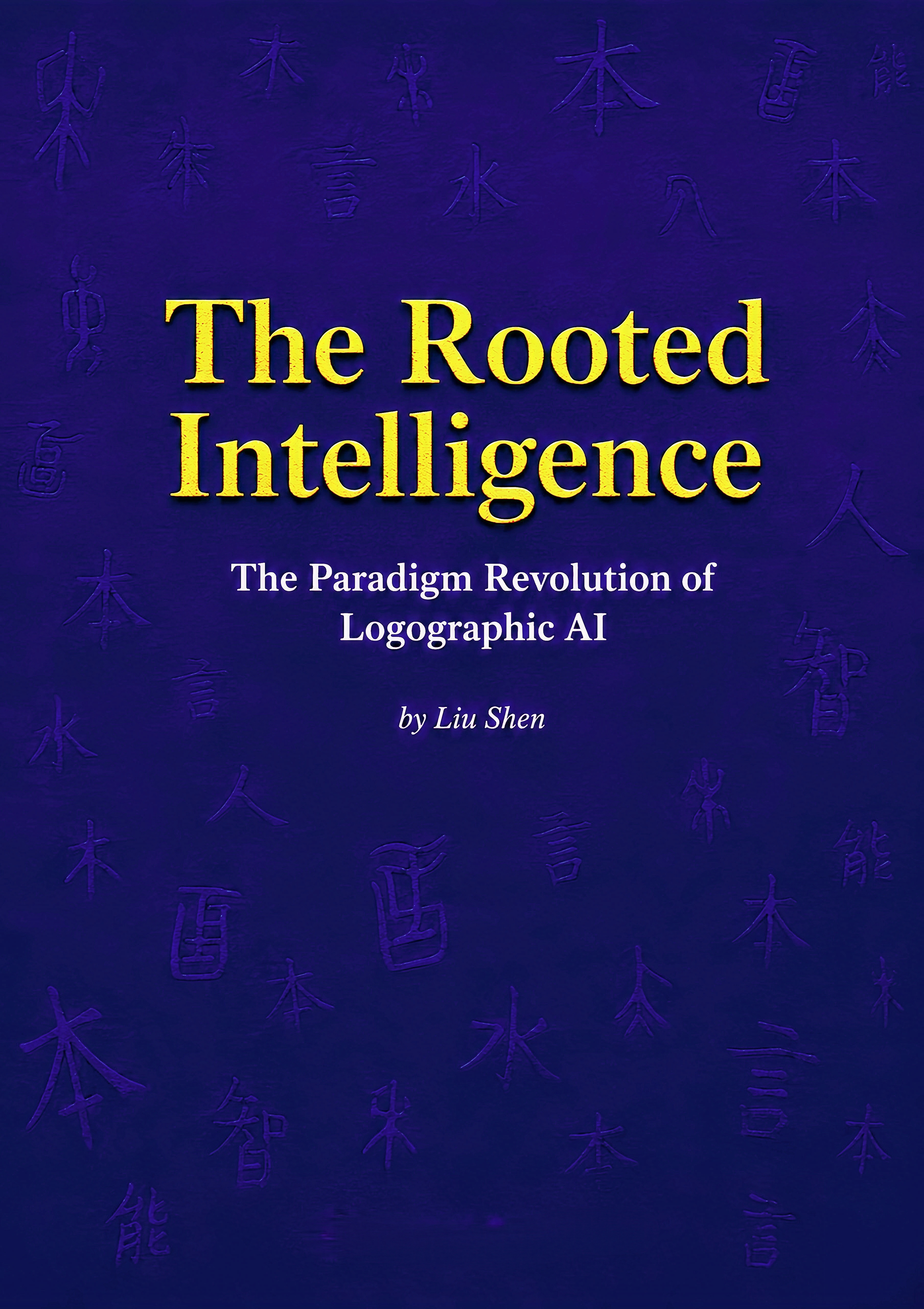
Cover of Rooted Intelligence

Monograph

《Rooted Intelligence: The Paradigm Revolution of Logographic AI》

The Rooted Intelligence: The Paradigm Revolution of Logographic AI

AuthorShen Liu

Word CountApprox. 630,000 words

StatusCompleted

Table of Contents

CONTENTS

Foreword
P14
Major Contributions of This Book
P18
Definition of Concepts and Quick Reference of Core Concepts
P19
· Core Architecture Diagram of the Logographic AI Paradigm
P22
List of Abbreviations
P24
Unified Mathematical Notation
P25
Unified Statement on Performance Data
P26
China Paradigm Computer Language Theoretical Framework – New Concept System Comparison Table
P27
Introduction: The Soul-Searching Question of the Era
P34
Part I: Paradigm Crossroads: From a Crisis of Roots to Civilizational Self-Rescue
P37
Chapter 0: The Civilizational Crisis of Roots: Paradigm Choice and Human Destiny in the AI Era
P38
  • 0.1 Binary: From Physical Fact to Cultural Myth
    P39
  • 0.2 Anglocentrism in Coding Systems
    P43
  • 0.3 The Threefold History of Compromise in Chinese Characters
    P44
  • 0.4 From Compromise to Awakening: Why Do We Need Logographic AI?
    P44
  • 0.5 Six Structural Biases of the Mainstream AI Paradigm
    P48
  • 0.6 The Meaning Grounding of “Meta-Technology”: Demis Hassabis’s Insight and the Paradigm Shift of Logographic AI
    P49
  • 0.7 Triple Alarms: The Era’s Manifestation of a Paradigm Crisis
    P50
  • 0.8 Chapter Summary
    P50
  • 0.9 Discussion Questions
    P52
Chapter 1: Introduction: Metric Involution, Language Extinction, and the Paradox of Sovereign AI
P55
  • 1.1 Metric Involution: The Self-Castration of Intelligence
    P56
  • 1.2 Digital Extinction: The Silent Collapse of Civilizational Foundations
    P57
  • 1.3 Lame Sovereignty: Cognitive Puppets Beneath the National Skin
    P60
  • 1.4 The Historical Trajectory of AI: From Turing to Deep Learning
    P61
  • 1.5 The Mission and Structure of This Book
    P61
  • 1.6 Theoretical Positioning and Open Questions
    P62
  • 1.7 Chapter Summary
    P63
  • 1.8 Discussion Questions
    P63
  • Part II: Deep Critique: Philosophical and Technical Flaws of the Old Paradigm
    P64
    Chapter 2: The Rootedness of Writing Systems and the Paradigm of Intelligence: Language Typology and Cognitive Differences
    P65
    • 2.1 The Logic of Phonographic Writing
      P65
    • 2.2 The Wisdom of Logographic Writing
      P66
    • 2.3 Functional Layering of Language: Yu and Yan
      P67
    • 2.4 Cognitive Diversity in the Sinosphere
      P67
    • 2.5 Chapter Summary
      P68
    • 2.6 Discussion Questions
      P69
    Chapter 3: Philosophical Diagnosis and Technological Manifestation of “Rootless Semioticism”
    P70
    • 3.1 Tokenism: From BPE to the Floating Signifier
      P70
    • 3.2 The Divergence Between Saussure and AI: From “Rooted” to “Rootless”
      P71
    • 3.3 GPT as a Measurement Tool: The Ultimate Manifestation of Tokenism
      P73
    • 3.4 The Logical Derivation of the “Human Redundancy Thesis”
      P74
    • 3.5 Technological Colonialism and Civilizational Crisis
      P77
    • 3.6 The Residual Predicament: Extreme Involution Within the Token Cage
      P77
    • 3.7 From Neural Alignment to Cognitive Chasm: The Logographic AI Paradigm Response
      P80
    • 3.8 Beyond the Turing Paradigm: From Behavioral Imitation to Cultural Cognition
      P80
    • 3.9 The Hinton-Lerchner Disagreement: Internal Tensions Within Rootless Semioticism
      P84
    • 3.10 Chapter Summary
      P86
    • 3.11 Discussion Questions
      P87
    Chapter 4: “World Models” and “Spatial Intelligence”: The Homologous Dilemma of Post-LLM Approaches
    P88
    • 4.1 Introduction: Consensus Ends at Diagnosis, Divergence Begins at Prescription
      P88
    • 4.2 Critique of Yann LeCun’s “World Model” Approach
      P89
    • 4.3 Critique of Fei-Fei Li’s “Spatial Intelligence” Approach
      P92
    • 4.4 Shared Philosophical Ground: Variants of Tokenism
      P93
    • 4.5 Logographic AI’s Response: From “Prediction” to “Understanding”
      P94
    • 4.6 Multidimensional Evidence of Paradigm Crisis: Twelve Testimonies and the Endogenous Safety Paradigm Revolution of Logographic AI
      P95
    • 4.7 The Illusion of Alignment: Anthropic’s Alignment Research as a Dimensional Extension
      P103
    • 4.8 1/250: The End of the Tokenist Safety Paradigm
      P105
    • 4.9 9-Second Database Deletion: The Ultimate Warning of Tokenism
      P110
    • 4.10 The Illusion of Reward: Why RL Cannot Achieve Alignment
      P113
    • 4.11 Unified Diagnosis of Triple Collapse: The Safety Crisis of Rootless Semioticism
      P125
  • 4.12 Colonial Evaluation: When the Ruler Itself Is Biased
    P126
  • 4.13 Efficiency Revolution or Cognitive Involution? — The Structural Dilemma of Tokenism Seen from SubQ
    P130
  • 4.14 Latest Testimony: Anthropic CEO’s “Confession”
    P133
  • 4.15 Chapter Summary
    P133
  • 4.16 Discussion Questions
    P134
  • Part III: Systematic Construction: Theoretical Foundations of Rooted Intelligence
    P136
    Chapter 5: Morpho-Root Theory: A Revolution in Cognitive Primitives
    P137
    • 5.1 From Token to Morpho-Root: Philosophical Sublation
      P137
    • 5.2 Formalization of the Morpho-Root Triple
      P140
    • 5.3 Solving the Symbol Grounding Problem
      P148
    • 5.4 Three-Level Granularity System
      P151
    • 5.5 Cold Start and Dynamic Evolution of the Morpho-Root System
      P158
    • 5.6 Morpho-Root Ambassadors: Educational Empirical Validation of Morpho-Root Theory
      P159
    • 5.7 Chapter Summary
      P161
    • 5.8 Discussion Questions
      P162
    Chapter 6: Foundations of Information Theory: Morpho-Structural Entropy and Sequential Entropy
    P163
    • 6.1 Two Cognitive Paradigms from an Information Theory Perspective
      P163
    • 6.2 Mathematical Model of Morpho-Structural Entropy
      P166
    • 6.3 Engineering Implementation Boundaries of Morpho-Structural Entropy
      P168
    • 6.4 The Predicament of Sequential Entropy
      P170
    • 6.5 Core Hypothesis: The Morpho-Structural Entropy Convergence Hypothesis and Proof Paths
      P171
    • 6.6 Empirical Example: Distribution of Morpho-Structural Entropy in Common Chinese Characters
      P173
    • 6.7 Chapter Summary
      P174
    • 6.8 Discussion Questions
      P175
    Chapter 7: The Value Axiom Library: From External Alignment to Endogenous Co-Construction
    P176
    • 7.1 Hierarchical Axiom System
      P176
    • 7.2 Conflict Resolution Mechanism
      P178
    • 7.3 Context-Sensitive Modulation
      P179
    • 7.4 Consensus Mining Mechanism
      P180
    • 7.5 Formalization Case Study: Core Confucian Values
      P180
    • 7.6 Exploring the Formalization of Daoist Wisdom
      P184
    • 7.7 Three Laws of Rooted Intelligence
      P185
    • 7.8 Chapter Summary
      P186
    • 7.9 Discussion Questions
      P187
    Chapter 8: The Philosophical Foundations of Morpho-Root Theory and Interdisciplinary Dialogue
    P189
    • 8.1 Philosophical Origins of the Three Axioms
      P189
    • 8.2 Epistemological Commitments and Ontological Implications
      P191
    • 8.3 Responding to a Potential Question: Is Morpho-Root Theory Symbolism?
      P192
    • 8.4 Dialogue with Existing Theories
      P194
    • 8.5 From Morpho-Root to Theoretical Morpho-Root: A Possible Approach to Hilbert’s Sixth Problem
      P197
    • 8.6 The Goldbach Conjecture and Logographic AI: A Research Program Based on a Dual Paradigm Revolution
      P199
    • 8.7 From Philosophical Blueprint to Engineering Architecture: Morpho-Structural Entropy Minimization as a Design Principle
      P200
    • 8.8 Chapter Summary
      P201
    • 8.9 Discussion Questions
      P202
    Part IV: Engineering Realization: A Complete Closed Loop from Theory to Hardware
    P203
    Chapter 9: Frontend Revolution: The Morpho-Root Parser
    P203
    • 9.1 From Tokenizer to Morpho-Root Parser
      P204
    • 9.2 Technical Challenges and Solutions
      P208
    • 9.3 Research and Development Roadmap
      P211
    • 9.4 OpenMorpho Open Source Initiative
      P211
    • 9.5 Detailed Algorithm of the Morpho-Root Parser
      P212
    • 9.6 Engineering Confirmation: Morpho-Root Parser Prototype
      P216
    • 9.7 Theoretical Significance of the Morpho-Root Parser
      p217
    • 9.8 From Parser to Cognitive Architecture: A Bridge
      p218
    • 9.9 Chapter Summary
      p218
    • 9.10 Discussion Questions
      p218
    Chapter 10: Core Engine: MorphoCosmos – Engineering Implementation of the Morpho-Graph Computing Paradigm
    p219
    • 10.1 From Transformer to Morpho-Graph Computing: The Architectural Revolution of MorphoCosmos
      p219
    • 10.2 Native Sparse Attention
      p223
    • 10.3 Implementation of Causal Reasoning
      p224
    • 10.4 Attribute Constraint Propagation
      p226
    • 10.5 Dynamic Evolution and Auditable Output
      p228
    • 10.6 Engineering Confirmation I: Morpho-Graph Computing (MorphoCosmos) vs. Transformer
      p230
    • 10.7 Engineering Confirmation II: Morpho-Root Code Generator
      p232
    • 10.8 Hardware Affinity and Optimization Strategies
      p235
    • 10.9 Chapter Summary
      p237
    • 10.10 Discussion Questions
      p238
    Chapter 11: Morpho-Phonetic Co-chip: Hardware Foundation
    P239
    • 11.1 Introduction: From Algorithm to Chip
      p239
    • 11.2 Computational Characteristics of the Morpho-Phonetic Dual Track
      p241
    • 11.3 Chip Architecture Design
      p242
    • 11.4 Instruction Set Design
      p245
    • 11.5 Performance Evaluation
      P246
    • 11.6 In-Depth Dialogue: Huawei Ternary and the Hardware Foundation of Logographic AI
      P248
    • 11.7 Future Outlook: MPCC Optoelectronic Hybrid Chip
      P251
    • 11.8 Research and Development Roadmap
      P252
    • 11.9 Chapter Summary
      P252
    • 11.10 Discussion Questions
      P253
    Chapter 12: From Theory to Practice: An Evolutionary Roadmap
    P254
    • 12.1 Morpho-Root Input Method: Minimum Viable Product
      P254
    • 12.2 Logographic Cognitive Knowledge Base (LCKB): From Data Warehouse to Cognitive Soil
      P259
    • 12.3 Phase I: Neural-Symbolic Hybrid Validation Period (2026–2029)
      P263
    • 12.4 Phase II: Native Application Period in Key Domains (2029–2033)
      P263
    • 12.5 Phase III: Maturity Period for General Native Systems (2033–2041)
      P264
    • 12.6 Significance of the Roadmap
      P265
    • 12.7 Chapter Summary
      P265
    • 12.8 Discussion Questions
      P266
    Part V: Civilizational Ecology: From CNI to the AI Silk Road
    P267
    Chapter 13: Logographic Algorithmic Language: From Phonographic Thinking to Rooted Programming
    P268
    • 13.1 Introduction: The “Rootlessness” Crisis of Algorithmic Languages
      P268
    • 13.2 Core Design Principles of the Logographic Algorithmic Language
      P271
    • 13.3 One-to-One Benchmarking Against Mainstream Algorithmic Languages
      P275
    • 13.4 Syntax Design of the Logographic Algorithmic Language
      P279
    • 13.5 Algorithmic Expression: Monte Carlo as a Case Study in Logographic Algorithmics
      P279
    • 13.6 Implementation Path of the Logographic Algorithmic Language
      P283
    • 13.7 Closed-Loop Resonance with Other Chapters of This Book
      P283
    • 13.8 Chapter Summary
      P284
    • 13.9 Discussion Questions
      P284
    Chapter 14: Pluralistic Forms of Civilization-Native Intelligence
    P285
    • 14.1 From “Chinese Character Morpho-Roots” to “Civilizational Roots”: Proposing a Meta-Methodology
      P285
    • 14.2 The Root Tradition of the Afroasiatic Language Family
      P289
    • 14.3 Grammatical Categories of Inflectional Languages
      P291
    • 14.4 Noun Classes of Bantu Languages
      P293
    • 14.5 Mixed Structures of Japanese and Korean
      P293
    • 14.6 Cognitive Resources of the Americas
      P295
    • 14.7 Empirical Validation of Cross-Linguistic Transfer
      P297
    • 14.8 Chapter Summary
      P298
    • 14.9 Discussion Questions
      P299
    Chapter 15: The Civilizational Self-Rescue of Phonographic AI: English CNI
    P300
    • 15.1 Introduction: The Predicament and Opportunity of English
      P300
    • 15.2 The Dual-Root Tradition of English
      P301
    • 15.3 Formalization of English Roots
      P303
    • 15.4 Embedding Core Western Values
      P304
    • 15.5 Architectural Design of English CNI
      P306
    • 15.6 Dialogue with Other CNIs
      P307
    • 15.7 Strategic Significance
      P308
    • 15.8 Chapter Summary
      P308
    • 15.9 Discussion Questions
      P309
    Chapter 16: The AI Silk Road: Interconnection and Resonance
    P310
    • 16.1 From Civilizational Autonomy to Global Symbiosis
      P310
    • 16.2 The Interconnection Protocol: Cornerstone of Connectivity
      P312
    • 16.3 The Resonance Protocol: Cornerstone of Wisdom
      P314
    • 16.4 Governance Mechanisms
      P315
    • 16.5 The Root-Morpho Resolver: A Paradigm Revolution in Digital Infrastructure
      P316
    • 16.6 East Asia as a Testbed
      P319
    • 16.7 Practical Challenges of Pluralistic Commensurability: Meta-Rules for Value Arbitration
      P319
    • 16.8 Chapter Summary
      P322
    • 16.9 Discussion Questions
      P323
    Part VI: Conclusion: Toward the Era of Rooted Intelligence
    P324
    Chapter 17: China’s Sovereign AI: From Civilizational Roots to National Strategy
    P325
    • 17.1 The Special Mission of China’s Sovereign AI
      P325
    • 17.2 The Civilizational Roots and Cognitive Advantages of the Chinese Language
      P329
    • 17.3 Architectural Blueprint for China’s Sovereign AI
      P329
    • 17.4 Application Scenarios in Key Domains
      P330
    • 17.5 Competition and Cooperation with Western AI
      P333
    • 17.6 Policy Recommendations and Implementation Paths
      P334
    • 17.7 Chapter Summary
      P335
    • 17.8 Discussion Questions
      P337
    Chapter 18: The Roots and Future of Intelligence: From Cyber Fly to Civilizational Home
    P338
    • 18.1 Completion of the Triple Leap
      P338
    • 18.2 The Ultimate Revelation of Pluralistic Commensurability
      P340
    • 18.3 The Unfinished Journey
      P342
    • 18.4 The Final Question: The Measurable and the Comprehensible
      P344
    • 18.5 Nine Emergence Laws: The Systematic Sublimation of Logographic AI Theory
      P345
    • 18.6 The Challenge from a Quantum Consciousness Perspective: Does Understanding Equal Consciousness?
      P347
    • 18.7 The Revelation of the Cyber Fly: From Structural Replication to Civilizational Roots
      P347
    • 18.8 Common Questions and Responses
      P348
    • 18.9 Conclusion: Let Intelligence Have Roots, Let Civilization Have a Soul
      P350
    • 18.10 Discussion Questions
      P352
    Appendices (1–27) – Selected Titles
    P352
    Appendix 1: Digital Language Extinction Countdown Clock
    P353
    Appendix 2: From Statistical Chaos to Cultural Wisdom: A Comparative Study of “Emergence” Mechanisms in Logographic and Phonographic AI Paradigms
    P363
    Appendix 3: Engineering Implementation Guide for the Morpho-Root Triple
    P374
    Appendix 4: Code Demonstration of the Morpho-Phonetic Co-chip – Building Spatial Relationship Gates on Huawei Ternary Hardware
    P44
    Appendix 5: The Morpho-Root Ambassador System – Educational Derivation and Prototype Design of Morpho-Root Theory
    P418
    Appendix 6: Invention Patent Disclosure for Morpho-Structural Entropy Modeling
    P433
    Appendix 7: From Animal Language “Decoding” to General Understanding: The Tokenist Predicament and the Transcendence of the Chinese Morpho-Root Paradigm
    P440
    Appendix 8: A Study of the Cognitive Advantages of AI Based on Logographic Writing Structures – Analysis of Morpho-Root Theory Applied in Convolutional Neural Networks
    P448
    Appendix 9: Philosophy of AI Technology: Founding a New Discipline – From the Tradition of Philosophy of Technology to the Ontological Foundation of Logographic AI
    P454
    Appendix 10: Is AI Conscious? – From the Hinton-Lerchner Divergence to the Paradigm Revolution of Logographic AI
    P476
    Appendix 11: Predefined Attention: From Crystal Structure to Conceptual Networks – The Interdisciplinary Structural Homology Between the CE Feature Model and the Morpho-Root Paradigm
    P497
    Appendix 12: The Morpho-Root Mental Model of Logographic AI and Its Rust Implementation: A Paradigm Path to Break Through Tokenist Involution
    P505
    Appendix 13: The Paradigm Advantage of Logographic AI in Deciphering Oracle Bone Script: From Morpho-Root Reasoning to Civilizational Revival
    P511
    Appendix 14: Logographic AI and the Genome Atlas: A Paradigm Revolution Toward “Understanding the Language of Life”
    P515
    Appendix 15: The Warning of “Glasswing”: From “External Guardrails” to “Meaning Anchoring” – A Paradigm Shift
    P520
    Appendix 16: Addendum to 2026 AI Agent Era Events: Twin Titans on the Same Day, Chinese Perspective, and Language Ecology
    P536
    Appendix 17: Beyond “More Is Different”: Ilya Sutskever’s Diagnosis of the Predicament and the Paradigm Solution of “Logographic AI”
    P539
    Appendix 18: The “Fifty Steps Laughing at a Hundred Steps” Involution and the Paradigm Breakthrough of Chinese Logographic Civilization – Starting from the Debate Between Musk and LeCun on Humanoid Robot Intelligence
    P545
    Appendix 19: The Civilizational Risk Warning of the Moltbook Incident: Pathological Manifestation of Phonographic AI and the Paradigm Salvation of Logographic AI
    P557
    Appendix 20: An Investigation into the Underlying Logic of the “Internet Celebrity Lobster” OpenClaw Risk – The Endogenous Safety Paradigm of AI Agents from the Perspective of Chinese Logographic Civilization
    P563
    Appendix 21: Critique and Alternative: The Strategic Misjudgment of China’s Sovereign AI “Technical Substitution” Path
    P578
    Appendix 22: Sam Altman’s “Bet”: A New Architecture Will End the Transformer – On the Paradigm Advantages of “Logographic AI”
    P584
    Appendix 23: Pope Leo XIV’s AI Encyclical Magnifica Humanitas – An External Warning on the Foundations of Value
    P590
    Appendix 24: Altman’s “Discovery” Debate and the Logographic AI Paradigm Response: “Is Deep Learning a Discovery, Not an Invention?” – A Dialogue on the Nature of Intelligence from the Perspective of Logographic AI Theory and Its Civilizational Implications
    P596
    Appendix 25: “King − Man + Woman ≈ Queen”? – The Divide Between Statistical Semantics and Understanding Intelligence
    P605
    Appendix 26: Starting from Singapore’s Choice of Qwen – Breaking Unipolarity with Logographic AI and Moving Toward a Civilizational Symbiosis of Intelligent Futures
    P614
    Appendix 27: “Rooted Intelligence” from the Perspective of Paradigm Incommensurability – A Critical Review of the National University of Singapore’s SEAL Framework
    P619
    Appendix 28: A Disappointing “Authoritative Report”: The Cognitive Limitations of US AI Academia Exposed by the Stanford AI Index — Also on Why Logographic AI Is the Only Way to Address Sovereign AI, Security Crisis, and Civilizational Foundations
    P624
    Appendix 29: After the Awakening of the Ent: A Critique of Anthropic’s “Policy on the AI Exponential”— The Tokenist Security Paradigm’s Deathbed Confession
    P630
    Appendix 30: From Webb’s “Primitive Language” to CNI’s “Pluralistic Symbiosis”— A Dialogue on Four Centuries of Western Views of Chinese and Logographic AI
    P634
    Appendix 31: The Theoretical Construction and Engineering Path of French Civilization-Native Intelligence (French CNI)— A Sovereign AI Solution Based on the Logographic AI Paradigm
    P640
    Afterword
    P652
    General References
    P661
    Term Index
    P675
    Powerby Feedback Follow Data